| The Ultimate Business Machine Technology, business And, not least, about by: Bernard Teo

|
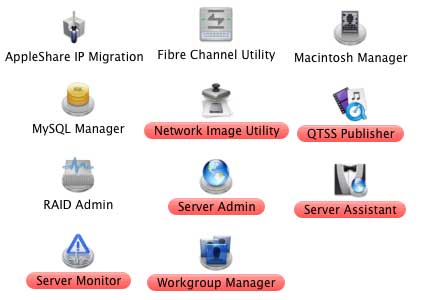
Mon 05 Apr 2004 logGenCategory : Technology/logGen.txt I read about logGen in MacSurfer on Saturday (which pointed to me to Macosxhints). It's interesting how things turn up just when you need them. This looks like what I need to keep track of the Perl modules. For example, if I install Date::Calc, I will get an output like this after running logGen : logGen -- version 1.0 45 new files: So this tells me that these are all the new stuff that came in with the Date::Calc installation, including all the modules Date::Calc depended on, and where you can find them. Neat. Even if I had monitored the terminal window like a hawk during the Date::Calc installation, I would never have figured this out. An alternative is to compare the state of the file system using two machines. (Actually I did that and realised I would have needed three machines, with one serving as the baseline.) But this would be too tedious and almost impossible to get right. So logGen is a great tool and I'm sure I can find even more use for it. I can see that the installation process wrote something into perllocal.pod. Perhaps there's a short cut to all this if I know enough about Perl and maybe the answers are all in the pod file. But you learn things any way you can. MacSurfer and why I need to think about what I'm writingCategory : Commentary/macsurfer.txt Oops. I didn't think MacSurfer would link to my last post. Why would they want to do that? You really got to think about what you're putting down in a weblog. One moment you're typing as you're thinking, in the quiet of an empty office on a Saturday morning (save for the sound of the Xserve), and the next they're all over the web. I'm thinking, maybe, "then, don't put it down". But I do have something to say - because you really got to understand what you're saying when you say that the Mac is so easy to use and it needs so little maintenance, because this could have actually worked against the Mac over the years. The way to solve this (but it's not easy) is to make the IT guys see that there are so many more interesting things they can do, if they can get quickly over the make-work stuff - like installing, configuring, pulling in and out expansion cards, setting dip switches, etc - and, more importantly, that they will be better rewarded if they do those other stuff. And what might these be? I believe it's an interesting job to try to understand, first, how a business makes its money, what revenues it has to bring in, and what costs it needs to incur doing that; and then, to work out what information it needs to control both the inflows and the outflows. You start off with empathy and curiosity, work the requirements through with creativity (guided by a vision of how technology could be made to substitute for any combination of land, labour or capital), and then finish off the work with a command of that technology. The problem is that most IT guys have no interest beyond technology, while most business owners have no interest in technology. I don't think we have to worry too much about the IT guys. They will go where the money is. At the moment, their thinking is probably, if we're so smart, then why are we not rich (after all, we've got barely 2% of computer users to work with)? I believe the solution is to find business owners who share a similar insight about technology, who're able to make out make-work from real work and will therefore reward accordingly, and then work, really work, to help them kill their competition. Or, if you can't find a business owner you can work with, find a business you can run with your own technology (just look at Entrepreneur.com - they have tons of business ideas), and then try to kill your competition. In either case, the key is to prove that you and your clients will get rich following the Mac Way of doing IT. (You've got include yourself in this quest; otherwise there's no point doing this). Nothing else, not even mega-AppleCentres, will be enough to win this game. Sat 03 Apr 2004 Postfix Enabler on Mac OS X Downloads PageCategory : Technology/PostfixEnableronMPGPage.txt Postfix Enabler has been placed on Apple's Mac OS X Downloads page, as well as on Mac Products Guide. I'm seeing quite a lot of hits and downloads. But no PayPal notifications. Oh, well. If everybody who uses it would just pay a dollar, I would be really rich this year. Maybe next time we have a good idea, we'd do something like that right from the start. It's been stuck on 1.0.9 for some time. I'm not sure if any of the things I'm doing over the next week will amount to a 1.1. Probably not. Maybe I could get a version with Michel Poulain's anti-virus filter incorporated, plus an ability to set up RBLs (Realtime Blackhole Lists). But I've said I would do that for some time, but I don't yet know how I'll find the time. The things I'm doing on Panther Server are a bit different. The idea is that quite a few enterprises (from large to small) would be interested in an Xserve - especially if it comes with spam and anti-virus filters (at the moment I only know how to do the SpamAssassin/Anomy thing) and the ability to produce detailed mail traffic analysis reports already bundled it. Now, these guys at Apple Singapore could come to me each time they need to ship this particular combination. But they would love it if I could build for them a Postfix Enabler-like installer. Then we've brought the costs down for everyone and presumably everybody's going to be happy. I've a slightly different take on the economics of doing this (actually, why would I want to do that? the more mystical the process, the more I can charge, so I'm working against my own interests; see, these issues are really subtle; no wonder people like John Nash, who studied game theory, went a bit awry), but of that another day. But this is the general idea. So why can't this be done for the donation-ware Postfix Enabler? Firstly, SpamAssassin is dependent on a collection of other Perl libraries. To get these built, you'll need to have Developer Tools loaded. Then, my impression is that these libraries are then installed all over the place (I'm going to spend a day or two confirming this). Postfix Enabler must have been downloaded at least 15,000 times. It'll be a nightmare to make sure everybody has Developer Tools installed and then to get all these Perl stuff loaded to the right locations. (I think Mike Poulain had the right idea with his anti-virus filter, though it does require Virex which comes with a .Mac account - his solution doesn't need all these dependent Perl libraries or Developer Tools - it'll work on any standard Mac). Then there is the idea of copyright and license agreements and whether I would be allowed to bundle things like SpamAssassin. The people who own UW-IMAP gave their permission readily for me to bundle it with Postfix Enabler. But it was still a bit of work to get it, as well as to add some stuff into the Postfix Enabler interface to help protect their interests. In the Panther Server case, I believe I can leave this to the other guys I'm working with to worry about. I'm trying to automate a process that would have to be done quite laboriously in-house, anyway, if I couldn't find a way to systematise the whole thing. Great, while writing this, the Panther Server installation on the Xserve is already done. It's fast, even on a G4. I'm just doing a Software Update, and then I'll be on my way. So I have two Panther Servers set up now - one on an iMac and the other on the Xserve. This way, I can keep one as the baseline to check what's loaded by default, and what came in as a result of my installations. Fri 02 Apr 2004 Panther Server AdministrationCategory : Technology/pantherserverreview.txt It doesn't take too long to install the Panther Server. Even on an old iMac. Most of the stuff you'll find loaded on the hard disk will be familiar to any Mac user - except for the server-specific applications you see below.
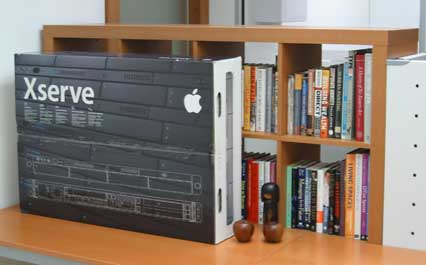
Of the lot, the Server Admin, Workgroup Manager, and the Server Monitor are the key applications. You can run these on any Mac and these, together with the Terminal application, will allow you to administer the server machine remotely. The Workgroup Manager is used to create new user accounts, organise them into groups, and set up their resource allocations, e.g., whether they're allowed to use the mail server, how much space they're allowed on the server hard disk, and, interestingly, how many pages they're allowed to print on each printer for whatever number of days (if this is what you want to control), among a few other features that I don't yet have the time to explore. The Server Admin application allows the administrator to turn on or off Internet services (like the web, mail, print and ftp servers), and control their individual settings. Finally, the Server Monitor is really meant for controlling the Xserve. Typically, the Xserve is placed on a server rack, without monitor or keyboard, and left in a server room. The Server Monitor allows the administrator to check on the physical state of Xserve - like its temperature and hard disk/memory utilisation - from wherever he happens to be. Of course, he can also use the Terminal application to log in remotely to the server and do things from the command line. So we'll be working with this beast on two levels - one on the surface using the admin apps, and another below the surface in the murky depths of Unix - and we'll see how these two interact. XserveCategory : Technology/Xserve.txt The Xserve looks deceptively thin and light on Apple's web pages. So it was a surprise how big and heavy the Xserve box is :
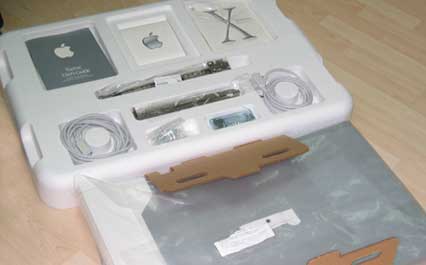
The next picture shows the contents, laid out on our floor :
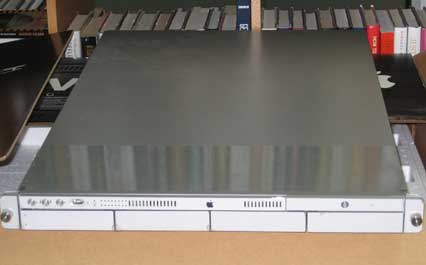
And the Xserve, itself. It's a G4, Dual 1 GHz, with 512 MB of RAM :
I've hooked it up to a PC monitor, borrowed the iMac's keyboard and mouse, plugged in the Ethernet cable, and turned it on. It's like a jet plane taking off. I mean the sound. It's loud. I'm going to have to live with this for the next two weeks. At this point, I don't think I'm going to miss it when it's gone. The Xserve starts up like any Mac. No, not like any Mac I'm currently using because it's fast. Very fast. How much faster would the new G5 Xserves be, then? It's looking good. It's currently running 10.2.8. I'm going to erase everything on it and start from scratch with 10.3. Then I realise I don't know where the CD-ROM drive is. Okay, found it. It's on the top right. Will carry on with the installation as soon as I can find the Panther Server CD's. Thu 01 Apr 2004 Panther Server on XserveCategory : Commentary/stuffOnXserveList.txt We're going to get an Xserve from Leon at Apple tomorrow. It's for the Sun Tech Day. I'm making a list of the things we're trying to get loaded on this machine : OS X Server 10.3.3 and Java 1.4.2. Xcode 1.1, Eclipse, NetBeans, JBuilder, and IntelliJ's IDEA to show the array of development tools that OS X can support. MySQL and Oracle. Plus the CVS system. Luca, our accounting application, hopefully both as a Cocoa application as well as on the web. And all of our Java demos that we built for the "Java on OS X" course. Plus, some demos from Leon's iDisk that I hadn't looked at yet. So if you're in Singapore on the 20th and 21st of April and want to see all these working on an Xserve, come and visit the Apple booth at Sun Tech Day, at The Stamford. Kamikaze FranchisesCategory : Commentary/franchise.txt It's the gold rush. It's the time to be your own boss. Or so everyone thinks. There are lots of free seminars one can attend about starting your own business. I attended a couple and I'm hooked - I'm going to sit in on a few more. Partly to clear my own head. But mostly to watch this tide run its course. Lots of people selling franchises. Great business, if you're the franchisor. Not so, if you're the franchisee. Too many people reading Robert Kiyosaki - and quite a few, I believe, are going to lose their shirts. The question is : what's the difference between a McDonald's and a child care centre or a computer-aided learning centre, when they're all sold as a franchise? Franchising is the easy way in. You can create your own business, buy over someone else's, or buy a franchise with all the templates, powerpoint slides, and letters to parents laid out for you. If you spent your whole life scoring A's in exams by memorising "model answers", which route would you take? But McDonald's have squeezed out almost all dependencies on the human element from their workflows and processes. That's the McDonald's way and it's the archetypical franchisable business. But nobody I know has figured out how to replace the quality a human being brings when it comes to taking care of a child, or motivating kids to learn through the joy of discovery. How much money can these businesses make, when the operators have no idea what it takes to create their products, do not understand the products they would be selling, and have left staffing as an afterthought? I think the key question to ask is : can the business produce a consistently high-quality product, when operated by any normal human being? In other words, have they found the key to making it work like a well-oiled machine, where a specific role can be performed by any mere mortal? Child care and learning centres are still businesses that ought to be run by people with a love for kids and helping them learn and grow. It's not like a method can't be found to systematise the delivery of these services. Somebody just might be able to find the right idea. But the ones doing the selling last night most definitely didn't. Then what are they selling? So some businesses will work as a franchise and some won't. The key is to figure out the rules of each game. Of course, anybody can attempt to sell any business as a franchise. But, caveat emptor, let the buyer beware. Because the would-be hunter might just end up as the prey. Wed 31 Mar 2004 "Tired of working? Be an entrepreneur"Category : Commentary/tiredofworking.txt This ad made me laugh so hard. I'm looking at the Business Opportunities section of the Straits Times classifieds. If you're going to be an entrepreneur just because you're tired of working, you're going to be hit so hard, you wish you hadn't been born. Welcome to the grind. But, seriously. Thu 25 Mar 2004 The Good (Computer) Books GuideCategory : Commentary/goodbooks.txt I'm going over the Panther Server, peeking under the hood, but I keep thinking about a couple of books I've read as I'm doing it. I don't know why but, maybe, I'm thinking about what it takes to put all these technologies together. Tracy Kidder's "The Soul of a New Machine" was probably the book that started the genre - the one that made reading about computers and computer companies fun. Who remembers Data General, or DG, or Damn Good, as their then Singapore-based GM called his company, when he gave a talk to us students, back in 1983? It's twenty years on. From the mini-computer to the workstation, to the iBook. I've worked on them all. The other hacker classic is - "Hackers" by Steven Levy. In there, you'll meet Richard Stallman, and recursive acronymns, and GNU's not Unix. If you haven't read them, then you ought to. If they work for you the way they worked for me, then you might also want to read : "Rebel Code", Glyn Moody, about Linux and the Open Source Revolution; Jeremy Campbell's "Grammatical Man"; Downes and Mui's "Killer App"; and Nicholas Negroponte's "Being Digital". Also, "Open Sources" - Voices from the Open Source Revolution, which is not that good, because it's really a collection of articles of varying quality, but interesting, all the same. Sun Tech DayCategory : Commentary/suntechday.txt There's a Sun Tech Day coming up on 20th and 21st of April 2004. We're going to be helping out Leon Chen and EC Tan at Apple's booth and lab session. Besides Apple, Oracle's also present. So we're going to load Oracle on an Xserve, and figure out what we want to show. Leon says that, at the previous show in Beijing, Apple's booth drew a lot of interest from the Java crowd. I think it's going to be fun. Guess which vendor is not going to be there? iSight - let me count the waysCategory : Commentary/mindset.txt The local Mac users are a feisty lot and up in arms over the poor product knowledge shown by the people selling Macs in Singapore, as this post shows. You can search the discussion group archives for a lot more of such comments, some of them quite funny. But, then, it's not all about complaints. More than occasionally, you get gems, like this from a guy called Timmy in reply to an earlier post about the usefulness (or, rather, lack of) of the iSight : "Well, the iSight is more than just a webcam. you can use it as a digicam too. let's say you're at a press conference or interview. just mount up your iSight, point it in the right direction, and hey, live video recording! can also use it as a mic to record audio of meetings, useful for minutes taking. "There are also fun apps like iStopMotion, I'm sure you can use iSight to make such movies. And then there is ToySight, can play games using iSight: it detects the motion of your hands to control the game!"
So, you learn so much more about what you can do with the iSight. Timmy would make a super Mac salesman. I think about some of the bicycle shops we have in Singapore, like Treknology and CycleWorx. Macs should be sold like that - by enthusiasts, to other enthusiasts. Between the Devil and the Deep Blue SeaCategory : Commentary/IT.txt Singapore is trying to get more people out of the public sector and into the private sector as entrepreneurs. But we've been doing this (dare we call ourselves entrepreneurs) for ten years and wondering, lately, if the smart ones are not the ones who stayed put (on their Herman Miller chairs). But then I read this article by Robert X. Cringely, "A Lose-Lose Situation - Sometimes IT Integration Just Isn't Worth the Trouble", and I'm reminded of just when and why we decided we wanted no part of that scene, anymore. Apple has a web page about Macs in business and the stories there pretty much describe where we're heading and what we want to help make happen - e.g., "My decision to go with Mac was based on two key criteria - the quality of the user experience, and reliability. The technology had to be transparent, intuitive, easy to use. So my staff and I would be happy and motivated and productive while using it." But all you have to do is read one article and you'll realise why Macs are such a hard sell with IT departments - "I'd worked with PCs at prior practices, and I knew they required a lot of IT support. And I didn't want to pay somebody a whole bunch of money to set up and administer a PC network, to worry about constant server patches and updates, port configuration and reconfiguration. With the Mac, I basically did it myself. I don't have an IT support contract, because I just don't need one. The beauty of a Mac network is that it pretty much configures itself! And that saves me thousands of dollars a year easily. "Finally, I wanted my staff to be as comfortable as possible using the technology. I didn't want to spend a whole lot of time training. With Mac, I trained my entire office staff myself. It took no time at all, because everything's just so intuitive. Click here, click there, and they were all very confident about using the Mac - even my previously technophobic nurse." I'm wondering how I'm going to make any money, myself. But, another story. I went with my friend, Ronnie, of Tarawerkz, a longtime Mac consultant and 4th Dimension developer, to the department in charge of Healthcare Computerisation here - he helped a doctor build a 4D-based patient records management system and now another hospital wants to use it. The catch is : he has to get past the IT Department. So, in the meeting, there are a couple of Information Architects (whatever that means), a Database Administrator, a Security "Expert", and a Network "Expert", and they're all grilling him on porting all these to Oracle (the favoured platform), conformance to their IS architecture, producing specifications, schemas, and data flow diagrams. They're doing what is called "due dilligence". Poor guy. There's very little money in it, and all this work before he's even awarded the job. In the middle of helping him explain how 4D could work with Oracle and Microsoft's Active Directory, my mind drifts and I see that all these guys don't need to care how long this takes because they're all on salary. They're walking all over this one guy's work but that guy is the only one in the whole room who's created anything of value - he's after all the guy who's built something that has worked, and that another hospital wants to use. It's like in American Idol. If being the judge pays so well, and you get to be nasty and condescending, and get paid well too, then why don't everybody be the judge? Everytime this happens, I'm thinking two words - Ayn Rand. Atlas Shrugged and The Fountainhead. Here's to John Galt and Howard Roark. Read more ... |
Mac@Work
Services running on this server, a Mac Mini running Mac OS X 10.9.2 Mavericks:
all set up using MailServe, WebMon, DNS Enabler, DNS Agent, VPN Enabler, Liya and our SQL installers, all on Mavericks. |
||||||||||||||||||||||||||